Chain Reaction, played on a relay
Drop an orb, take a cell, and when a cell holds one orb too many it bursts into its neighbours, and their neighbours. Chain Reaction runs in an Obelisk channel with no game server; every client replays the same event log and reaches the same board.
The rules, in four lines
- Click a cell that is empty or already yours. It gains one orb.
- A cell bursts when it holds as many orbs as it has neighbours: 2 in a corner, 3 on an edge, 4 in the middle.
- When it bursts, one orb goes into each neighbour, and every one of those cells becomes yours.
- Bursting can make a neighbour critical too, so one click can roll across the board. Lose all your orbs after your first move and you are out; last player standing wins.
That is the whole game. It is small enough to explain in a sentence and deep enough that a corner you ignored for six turns eventually takes half your board.
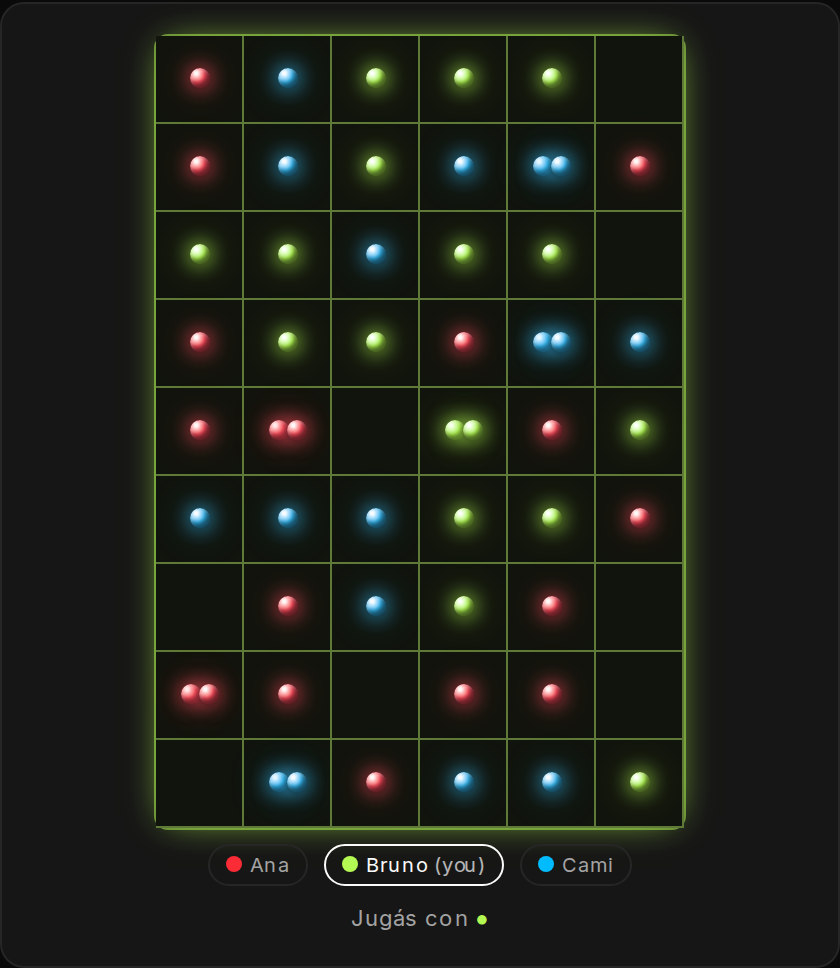
Starting a table
Type /play in a channel, pick Chain Reaction, and choose a board size (small 5×7, medium 6×9 or large 8×12) and a turn clock. Creating the table publishes one event and posts a card into the channel. Anyone in the channel can hit Join on that card; when the roster looks right, the host hits Start.
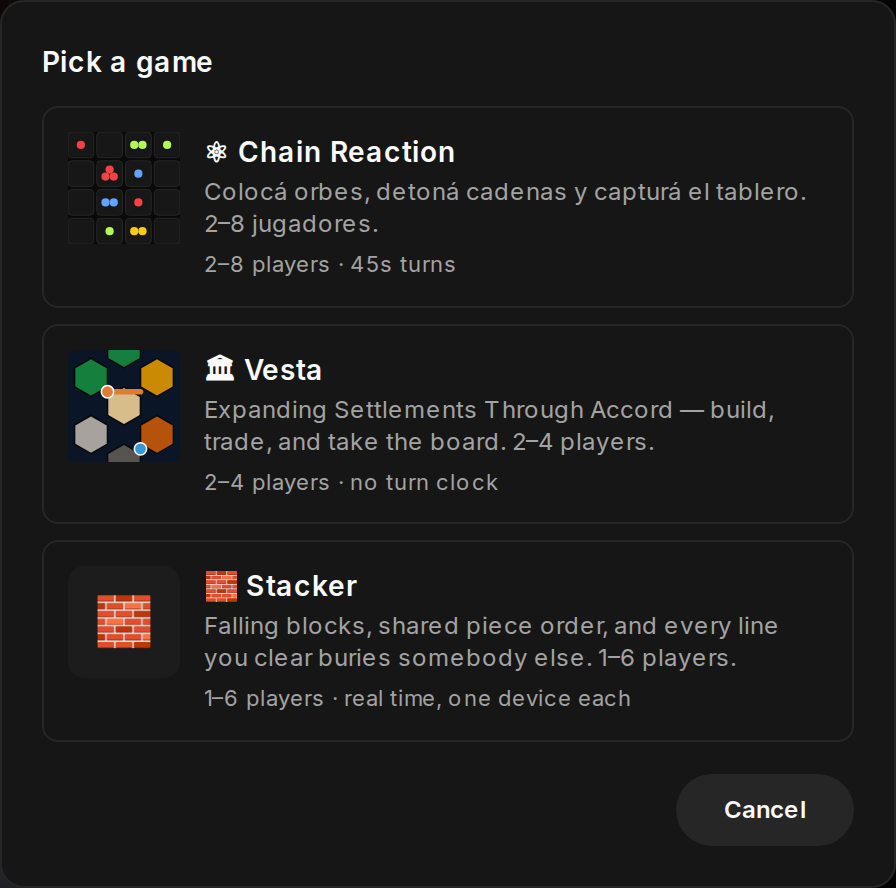
Chain Reaction seats 2 to 8 players and defaults to a 45-second clock. If several seats are assigned to the same account, those players are sharing one keyboard: the board follows whoever is on move, and their moves are signed by the same key. Everyone else plays from their own client.
What actually crosses the wire
A move is one event. Not a board, not a cascade. A cell number:
{
  "kind": 2390,
  "tags": [
    ["h", "<channel-id>"],
    ["t", "obelisk-game"],
    ["op", "move"],
    ["e", "<table-id>", "", "root"],
    ["n", "17"]
  ],
  "content": "{\"n\":17,\"action\":{\"cell\":11},\"seat\":\"<seat-id>\"}"
}
Your client publishes that to the channel's relay, the relay hands it to everybody subscribed, and every client, yours included, runs the same reducer over the same log. The explosion you watch is your own machine replaying the cascade the rules imply. Nobody sends you a board, because nobody has a more authoritative one than you do.
Why a cheating client gets nowhere
Every client validates every move before applying it, so an event that breaks a rule is dropped everywhere at once. Concretely, a move is only applied when:
- it is signed by the account that controls the seat on move;
- it carries the current turn number
n(a move published against a stale board fails here); - the engine says the cell is legal (empty, or already yours).
Publishing an illegal move is not an exploit; it is publishing noise. Ordering is decided by (created_at, id), and the id is a hash, so two events landing in the same second break the tie identically on every machine. Nobody's clock skew reorders your match.
The turn clock without a server
There is no timer process anywhere. The deadline is derived from the log: the turn started when the last accepted event landed, and it expires turnTimeoutS later. Once that moment passes, any player may publish a timeout claim for that turn. Everyone else checks the claim against the same log and reaches the same verdict, so the first valid one is accepted and the rest are harmless duplicates.
Pick No clock and nothing enforces anything: a friendly table where somebody wanders off simply waits. That is a fair trade for a game with friends and a bad one with strangers.
When it ends
A player who has moved at least once and then loses every orb is eliminated. When one player is left, the table is finished and the card in the channel turns into a result.
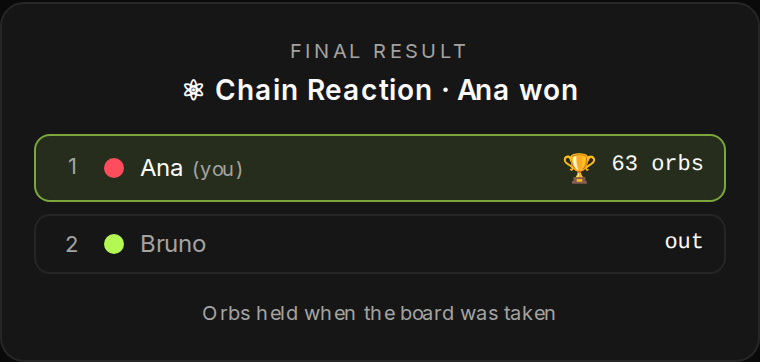
The result is not a separate announcement anybody could forge; it is what the log says when you replay it.
What it does not protect you from
- Privacy. Moves are plaintext on the relay, like the chat messages beside them. Chain Reaction has no hidden information, so there is nothing to leak; a game that did (poker, battleship) would need a commit-reveal scheme on top.
- Someone who walks away from a no-clock table. See above.
- Seat order. The host picks it, and turn order is a real advantage on a small board.
- A player using an engine. Nothing here can tell a thoughtful human from a solver.
For the curious
The whole thing is kind 2390 events in the channel's group, replayed by src/lib/games/session.ts. The engine (chain-reaction.ts) is a pure function: no clock, no randomness, no mutation. That is the entire reason it can be trusted to a client. If you want the wire format op by op, it lives in docs/features/games.md.